
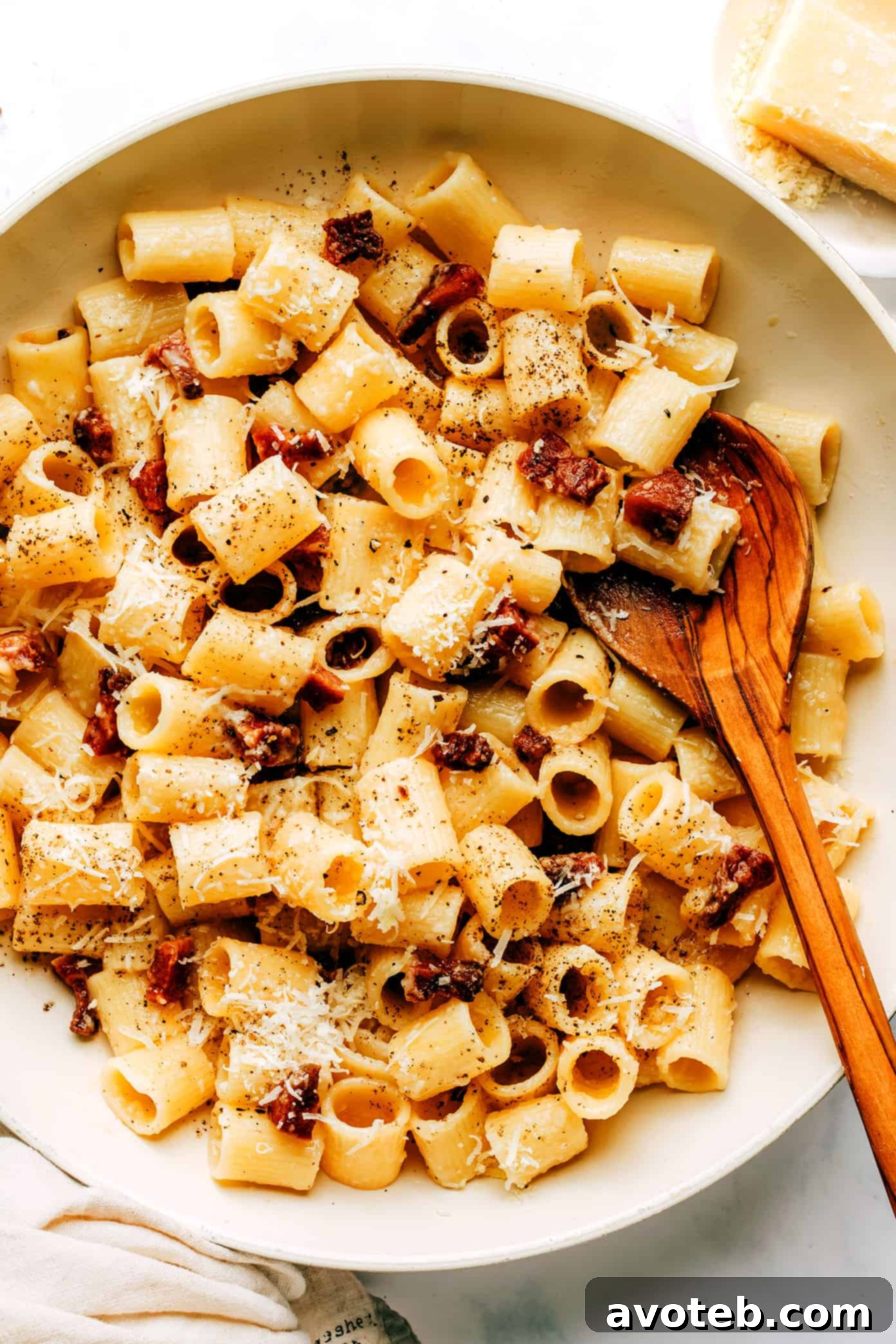
This classic pasta alla gricia recipe is an ode to Roman culinary simplicity, crafted with just a few core ingredients, yet bursting with incredibly rich and complex flavors.
For aficionados of rich, savory pasta dishes, especially those who cherish the iconic Carbonara, allow us to introduce you to its lesser-known, yet equally magnificent, cousin: Pasta alla Gricia. Often dubbed “Amatriciana without the tomatoes” or “Carbonara without the eggs,” Gricia holds a distinct and honored place among Rome’s revered quartet of pasta dishes. Its simplicity belies a depth of flavor that is truly remarkable, making it a timeless classic that has captivated palates for centuries.
Until recently, even I hadn’t fully appreciated the profound elegance of Gricia. My culinary journey through Europe opened my eyes to this staple of Italian menus, a dish that proudly stands alongside its more famous siblings: Cacio e Pepe, Carbonara, and Amatriciana. As a long-time admirer of these Roman giants, I eagerly embraced the opportunity to delve into Gricia. Years later, after countless batches and endless experimentation, this humble dish has cemented its status as an undeniable favorite in my kitchen and heart.
At its core, Pasta alla Gricia celebrates the synergy of three fundamental ingredients: pasta, cured pork, and aged cheese. The true star, however, is guanciale, the exquisitely cured pork cheek renowned for its intensely rich, salty, and savory profile. When rendered slowly to a perfect crisp-chewy texture, its fat becomes the luxurious foundation of the sauce. This golden fat then masterfully emulsifies with starchy pasta water and finely grated Pecorino Romano cheese, transforming into a silky, glossy coating that clings lovingly to every strand of pasta. This ancient technique, perfected over more than a thousand years, results in a dish that is deeply comforting, surprisingly layered in flavor, and utterly irresistible. In our home, it’s a dish we simply can’t get enough of.
The secret to mastering all four classic Roman pastas, with their deceptively short ingredient lists, lies not just in the components themselves, but in the meticulous application of proper techniques. Over the years, I’ve explored numerous alla Gricia recipes, noting variations primarily in ingredient ratios and the simmering duration of pasta in the guanciale-infused sauce. While I humbly acknowledge that I am not a native Italian culinary expert, I have meticulously refined a method and a set of ratios that consistently yield the most delectable results for me. Today, I am thrilled to share this tried-and-true approach with you, hoping it inspires your own Roman pasta adventure.
This Pasta alla Gricia recipe is designed for both ease and exceptional flavor. It can be prepared in approximately 30 minutes, delivering a rich, bacon-y experience without feeling excessively greasy. It incorporates crucial steps that ensure the Pecorino Romano melts flawlessly into a perfectly emulsified, glossy sauce, preventing that unfortunate tendency for cheese to clump or stick to the pan. For an authentic and bold pork flavor, I strongly advocate seeking out high-quality Italian guanciale. Coupled with excellent pasta and genuine Pecorino Romano cheese, these ingredients are key to the sauce’s magic. However, if guanciale or Pecorino are not readily available in your area, I’ve included practical substitution notes below for pancetta (or even good-quality bacon) and Parmesan, which, while not traditional, will still produce a wonderfully delicious meal.
Now, let’s embark on this culinary journey and create some exquisite pasta together!
Pasta alla Gricia Recipe | Quick Overview
Mastering Pasta Alla Gricia: The Essential Ingredients
Before diving into the full recipe, understanding the role of each primary ingredient is crucial for achieving authentic Roman flavor:
- Guanciale: The undisputed star of Pasta alla Gricia, this exquisitely cured pork cheek delivers an unparalleled depth of flavor. Its rich, salty, and intensely porky essence, combined with its unique crisp-chewy texture, is truly phenomenal. Guanciale is typically seasoned with black pepper during its curing process; if yours isn’t, consider adding a generous pinch of freshly ground black pepper to the dish. For this recipe, you’ll need to cut the guanciale into thick, bite-sized pieces, keeping in mind they will shrink considerably during cooking due to its high fat-to-meat ratio. While I wholeheartedly recommend authentic Italian guanciale for the best results, good-quality pancetta or even thick-cut bacon can serve as substitutes if guanciale is unavailable. (Further substitution notes are provided below for detailed guidance.)
- Pecorino Romano: This sharp, salty, and tangy aged sheep’s cheese is an integral component of Roman pasta tradition. Its distinctive grassy notes and robust flavor are essential for balancing the richness of the guanciale. For optimal melting and sauce consistency, always ensure you finely grate the Pecorino by hand just before use. Precise measurement by weight is also important to maintain the perfect balance in the sauce.
- Pasta: The choice of pasta shape is important, as it impacts how the sauce clings to each bite. Traditionally, alla gricia is prepared with rigatoni, spaghetti, or bucatini. Rigatoni’s ridges and hollows capture the rich sauce beautifully, while spaghetti or bucatini (a thicker, hollow spaghetti) offer a classic Roman experience. However, feel free to use any good-quality, sturdy pasta shape you have on hand that can stand up to a rich sauce.
- Salt and Freshly-Ground Black Pepper: These foundational seasonings elevate and complete the dish. Fine sea salt should be used sparingly, as both guanciale and Pecorino Romano are inherently salty. Freshly-ground black pepper, added towards the end, provides a warm aromatic kick and is crucial to the dish’s profile. Avoid pre-ground pepper for the best flavor.
Unlocking Perfection: Key Tips for Making Pasta Alla Gricia
While the full, detailed instructions for crafting this delightful Pasta alla Gricia are provided in the recipe section below, here are some crucial tips to ensure your dish is nothing short of spectacular:
- Prepare by Reading the Recipe Thoroughly: This recipe, though straightforward, involves a dynamic and quick cooking process where timing is key. Before you even turn on the stove, take a few minutes to read the entire recipe from start to finish. Understanding the flow of steps will make the multitasking much smoother and prevent any last-minute rushes.
- Always Finely-Grate Your Cheese by Hand: This cannot be stressed enough. Store-bought pre-grated cheeses often contain anti-caking agents (like cellulose) that prevent them from melting smoothly, resulting in a grainy or clumpy sauce. For that signature glossy, emulsified Roman sauce and superior flavor, use a microplane or your preferred fine grater to freshly grate the Pecorino Romano immediately before you plan to add it to the dish.
- Select a Generously Sized Sauté Pan: You’ll need ample space to vigorously toss the pasta with the sauce to achieve proper emulsification. A large sauté pan (at least 12 inches) with high sides will provide the necessary room, preventing spills and allowing for efficient mixing. For even better results and easier cleanup, consider using a high-quality non-stick sauté pan, which also helps prevent the cheese from sticking—a common tragedy when making cheese-based pasta sauces.
- Keep Your Strainer or Tongs Within Reach: Efficiency is vital when transferring the pasta. A spider strainer is ideal for short pasta shapes like rigatoni, allowing you to scoop the pasta directly from the boiling water to the sauté pan while retaining valuable starchy pasta water. For long noodles like spaghetti or bucatini, a sturdy pair of tongs works perfectly. If these tools aren’t available, have a heatproof measuring cup ready to scoop out at least 2-3 cups of starchy pasta water before draining the pasta in a colander and immediately transferring it to the pan.
- Master the Art of Starchy Water Addition: The starchy pasta water is the unsung hero of this dish, crucial for creating the perfect emulsion and finishing the pasta to al dente perfection within the sauce. Since the pasta will continue to cook and absorb liquid in the pan, it’s essential to maintain a moist environment. Whenever the sauce appears too dry or starts clinging too tightly to the pasta, add a quarter-cup of the reserved starchy pasta water, stirring continuously until the desired consistency is achieved. Err on the side of having more starchy water than you think you’ll need.
Recipe Variations and Thoughtful Substitutions
While the classic Pasta alla Gricia shines brightest with its traditional components, here are a few non-traditional yet delicious variations and substitutions you might explore:
- Pancetta or Bacon as Guanciale Alternatives: Should authentic guanciale prove elusive, good-quality pancetta or even thick-cut bacon can be used. However, be aware that these substitutions will alter the dish’s flavor and texture profile. Guanciale, cured for a longer period and boasting a higher fat-to-meat ratio, delivers an intensely rich and distinctively savory flavor. Pancetta, a different cut of pork with varied seasonings and a shorter curing time, is the closest alternative, offering a similar (though less intense) flavor. Bacon, with its characteristic smoky notes, will impart a noticeably different taste. Regardless of your choice, all three will yield a delicious result, so feel free to use what is accessible and suits your preference.
- Parmesan Cheese as a Substitute for Pecorino Romano: Parmigiano-Reggiano, while not the traditional cheese for Gricia, can serve as a delightful substitute if Pecorino Romano is unavailable. Its nutty, less sharp flavor will create a different but still appealing sauce. Alternatively, a blend of both cheeses can offer a unique complexity. Just remember to grate it freshly for the best melting performance.
- Infuse a Hint of Heat with Crushed Red Pepper Flakes: For those who appreciate a subtle kick, consider adding a pinch of crushed red pepper flakes to the rendered guanciale fat along with the black pepper. While this is not a traditional Roman addition, it introduces a wonderful warmth and depth that many find enjoyable.
- Make it Gluten-Free: This recipe is easily adapted for those with gluten sensitivities. Simply choose a high-quality gluten-free pasta that you enjoy. Ensure it holds its shape well and cooks to a pleasant al dente texture.
Pasta Alla Gricia: Frequently Asked Questions
Delve deeper into the fascinating world of Pasta alla Gricia with these insightful questions and answers:
- How do you pronounce “gricia”? The Italian pronunciation is GREE-cha, with a soft ‘g’ sound, similar to the ‘j’ in “jump.” You can hear a clear pronunciation here.
- What exactly is pasta alla gricia? It is one of the four iconic Roman pasta dishes, characterized by its elegant simplicity. It’s traditionally made with pasta (often rigatoni, spaghetti, or bucatini), crispy guanciale (cured pork cheek), finely grated Pecorino Romano cheese, and a generous amount of freshly ground black pepper. Crucially, it contains no tomatoes or eggs.
- What are the origins of pasta alla gricia? Pasta alla Gricia hails from Lazio, the beautiful Italian region where Rome is located. It is believed to be a very ancient dish, possibly predating Amatriciana and Carbonara. It’s often considered the “ancestor” or “white” version of Amatriciana.
- What does the term “gricia” mean in Italian? The exact origin of the name “gricia” is debated among food historians and linguists, with several compelling hypotheses. One theory suggests the dish is named after Griciano, a small village in Lazio where it is thought to have originated. Another postulates a connection to the “grici,” who were early food vendors in the area, particularly those selling bread and cured meats. ¹ A more evocative theory links the name to the charcoal-gray color left in the pan after the guanciale was fried, a subtle visual nod to its preparation. ²
- How does alla gricia differ from carbonara and amatriciana? Alla Gricia is often described by its relationship to these other Roman classics:
- It is similar to Carbonara but conspicuously lacks eggs, which are central to Carbonara’s creamy sauce.
- It is similar to Amatriciana but famously omits tomatoes, making it a “white” sauce in contrast to Amatriciana’s rich red hue. Essentially, Alla Gricia is Amatriciana without the tomatoes.
- Can I use regular bacon instead of guanciale? While you *can* use regular bacon, especially thick-cut, it’s important to understand it will change the flavor profile. Bacon is typically smoked, which will impart a smoky note not found in traditional Gricia. Guanciale is salt-cured, not smoked, and its fat has a distinct, deep pork flavor that is unmatched.
- What is the best way to store leftover Pasta alla Gricia? Leftovers can be stored in an airtight container in the refrigerator for up to 2-3 days. To reheat, gently warm in a pan over low heat, adding a splash of water or chicken broth to loosen the sauce and revive its creaminess.
- What wine pairs well with Pasta alla Gricia? A dry, medium-bodied white wine like a Frascati or a Vermentino, or a light-bodied red like a young Sangiovese, would complement the richness of the dish without overpowering it.
Pasta alla Gricia
Author: Ali
Prep Time: 5 mins
Cook Time: 30 mins
Total Time: 35 mins
Yield: 4 servings
Description
This classic Roman pasta alla gricia recipe is surprisingly easy to make with just three main ingredients—guanciale, Pecorino Romano, and pasta—and consistently delivers a decadent, flavorful meal.
Ingredients
Scale
- 8 ounces guanciale*
- fine sea salt and freshly-ground black pepper
- 12 ounces uncooked pasta (Mezzi rigatoni or spaghetti recommended)
- 2 ounces finely-grated Pecorino Romano
Instructions
- Prepare the Guanciale. Begin by slicing the guanciale into ¼-inch-thick pieces. Then, cut each slice into smaller, roughly ½ x 1-inch bite-sized pieces. For easier cutting, you may find it helpful to briefly freeze the guanciale for about 10 minutes beforehand.
- Render the Guanciale. Place a large sauté pan (a non-stick pan is highly recommended for best results) over medium-low heat. Add the prepared guanciale to the dry pan and cook slowly, stirring and flipping occasionally, until the guanciale pieces are beautifully golden brown and crispy, and a substantial amount of its rich fat has rendered into the pan. This process usually takes about 10 minutes; be sure to monitor it closely to prevent burning. Using a slotted spoon, carefully transfer the crispy guanciale pieces to a separate plate, leaving the rendered fat in the pan. Pour the accumulated fat into a heatproof measuring cup. Measure out precisely ¼ cup of this precious fat and return it to the sauté pan; discard any excess.
- Bloom the Black Pepper. To the hot guanciale fat remaining in the pan, add 1 teaspoon of freshly-ground black pepper. Stir it into the hot fat for about 30 seconds to allow its aroma to bloom, then immediately turn off the heat to prevent it from burning.
- Cook the Pasta. While the guanciale is cooking, fill a large stockpot about halfway with water (approximately 3 quarts) and bring it to a rolling boil. Since the guanciale and Pecorino Romano are quite salty, you only need to add 1 tablespoon of fine sea salt to the pasta water. Add your chosen pasta and cook for 8 minutes, stirring occasionally to prevent sticking.
- Begin the Sauce Emulsification. At the 6-minute mark of the pasta cooking time, carefully scoop out 1½ cups of the starchy pasta water from the pot and transfer it to the sauté pan containing the guanciale fat and bloomed pepper. Turn the heat of the sauté pan to high to quickly bring the mixture to a boil. Gently stir the liquid, encouraging the starchy water and fat to emulsify as the sauce begins to reduce slightly.
- Finish Pasta in the Sauce. Once the pasta reaches the 8-minute mark and is still very al dente, use a spider strainer or tongs to immediately transfer the pasta directly from the stockpot to the sauté pan with the sauce. Continuously toss the pasta in the simmering sauce for an additional 3-5 minutes. During this time, the sauce will continue to reduce and emulsify, and the pasta will finish cooking to a perfect al dente texture, absorbing the rich flavors. If the sauce becomes too dry at any point, add an extra ¼ cup of the remaining starchy pasta water as needed to maintain a glossy consistency.
- Final Emulsification and Serving. Turn off the heat from the sauté pan. Return the reserved crispy guanciale to the pan along with half of the finely grated Pecorino Romano cheese. Toss gently but continuously to thoroughly combine. Now, add the remaining Pecorino Romano and continue to toss until the cheese has completely melted, creating a beautifully glossy and smooth sauce that coats every piece of pasta. If the sauce appears too thick or needs further thinning, add an additional few tablespoons of the remaining starchy pasta water, stirring until desired consistency is reached.
- Serve Immediately. Plate your Pasta alla Gricia without delay, as this dish is best enjoyed fresh. Garnish each serving with an extra sprinkle of Pecorino Romano cheese and a final twist of freshly ground black pepper for a perfect finish.
Essential Equipment for Pasta alla Gricia
Spider Strainer
Buy Now →
Fine Grater
Buy Now →
Nonstick Pans
Buy Now →
Notes
Guanciale: For detailed information on substituting with pancetta or bacon, please refer to the “Recipe Variations and Thoughtful Substitutions” section above.
Source: This recipe has been thoughtfully adapted and refined from the excellent methodology presented by Serious Eats, ensuring a balance of authenticity and accessibility for home cooks.