
(A quick note on terminology: For reasons related to online content flagging and ensuring broad accessibility, I will be using dashes when referring to the P-word throughout this article. My aim is to convey my message clearly while keeping this site family-friendly. Thank you for your understanding.)
Beyond the Buzzword: Why It’s Time to Rethink “Food P–n” in Culinary Discourse
As someone deeply immersed in the vibrant world of culinary arts and food photography, my passion for delicious dishes is an open book. I genuinely adore every step of the process: experimenting with new recipes, carefully styling each plate to highlight its textures and colors, breathing in those irresistible aromas as I lean in for the perfect close-up, and eagerly sharing these visual stories across my blog and social media platforms. There’s immense joy in connecting with others through the universal language of food, whether I’m admiring the inspiring creations of fellow food bloggers or discovering new recipes that spark my own creativity. Indeed, this deep love for capturing and presenting food has blossomed into a fulfilling full-time career for me over these past few years.
However, amidst this delightful engagement with food culture, there’s one widely used term that consistently gives me pause: “food p–n.”
While I’ve never made a public spectacle of my feelings about it, nor do I ever judge others for using this descriptor, I feel compelled to share my perspective. Operating daily within the food photography sphere, I completely grasp the term’s origins and understand precisely why it became such an effective and pervasive buzzword. Its ubiquity online is undeniable, especially in an era where virtually every smartphone boasts a high-quality camera, leading to an endless stream of food photos – some truly stunning, others less so – flooding social media feeds and the broader internet. For the most part, I acknowledge that many people perceive this term as entirely innocuous, a simple way to express intense visual appeal.
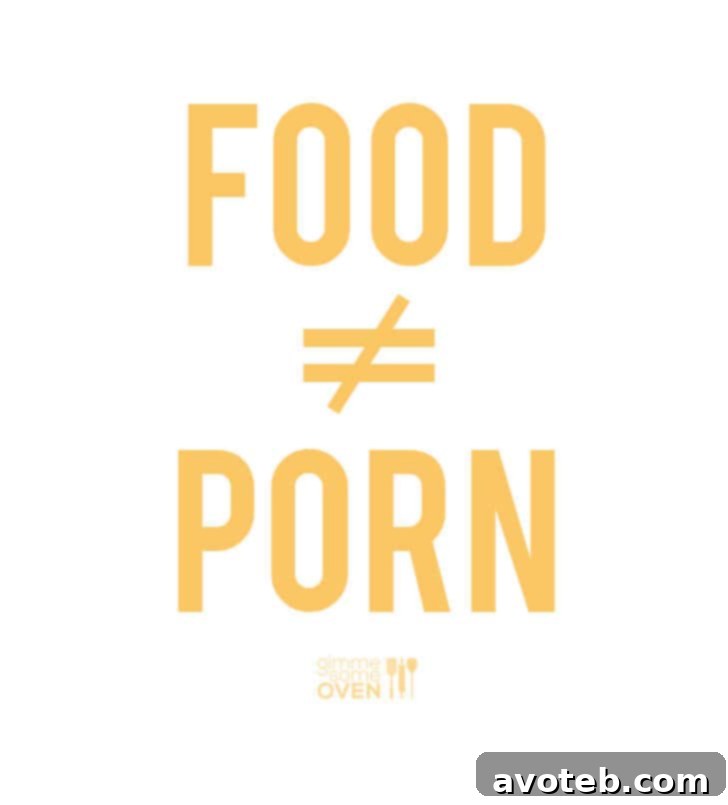
Yet, even after encountering the term for countless years, I still find myself subtly cringing whenever it surfaces. My discomfort isn’t rooted in any religious dogma, nor do I consider myself naive or overly sensitive to modern parlance. Instead, it stems from a profound and simple conviction: we can articulate ourselves better. We can find a more intelligent, accurate, and respectful vocabulary to describe food for its inherent qualities. A choice of words that doesn’t inadvertently glamorize, normalize, or lend any unearned credibility to an industry with which food, in its essence, shares absolutely no meaningful connection.
When I recently conducted an online search for “food p–n,” the results were staggering – hundreds of millions of hits – underscoring its widespread adoption. Yet, I struggled to uncover a single discussion that explored the term from the nuanced perspective I’m presenting here. This realization solidified my belief that this topic warranted a dedicated blog post, despite anticipating that many readers might hold differing viewpoints. I sincerely invite you to consider the arguments I lay out.
Understanding the Multifaceted Interpretations of “Food P–n”
For those fortunate enough not to encounter the term regularly, it’s worth noting that “food p–n” carries different connotations for different individuals. Wikipedia offers a comprehensive definition, stating that “food p–n is a glamorized spectacular visual presentation of cooking or eating in advertisements, infomercials, cooking shows or other visual media, foods boasting a high fat and calorie content, exotic dishes that arouse a desire to eat or the glorification of food as a substitute for s-x. Food p–n often takes the form of food photography and styling that presents food provocatively, in a similar way to glamour photography or p–nographic photography.”
From my professional vantage point, my definition often distills down to two primary uses. On one hand, people employ the term quite positively, utilizing it to describe food media and food styling that they genuinely adore, conveying an intense passion and appreciation for its visual allure. On the other hand, it’s frequently used negatively, perhaps to critique a poorly executed food photograph, or to express frustration over what they perceive as an excessive volume of food-related content posted by an individual. Interestingly, some restaurateurs have reportedly started actively discouraging or even outright banning “food p–n” photography in their establishments, weary of customers capturing unflattering images that misrepresent their meticulously prepared and beautiful dishes. (I’m genuinely curious to know how successfully such policies have been implemented and received!) And, it must be acknowledged, there are admittedly those who take the comparison quite literally, attempting to style food to mimic the explicit nature of the P-word industry, which, frankly, completely misses the profound point of culinary art and can be quite unsettling.
However, for the vast majority of people, it seems to function as a casual, albeit problematic, shorthand for describing food that looks incredibly appealing and elicits a strong, immediate desire to consume it.
The Problematic Parallel: Why This Analogy Falls Critically Short
To reiterate, my stance on this issue is purely personal and reflective of my own values. The fundamental problem for me is unequivocally clear: food is, by its very nature, not the P-word. While I largely champion the ethical values and creative endeavors represented by the food industry (most of the time, anyway), I staunchly and firmly reject everything that the P-word industry embodies. There are myriad profound reasons for this conviction, which I won’t detail extensively here, but it’s vital to remember that the P-word industry is a multi-billion dollar enterprise. It operates all too frequently in the shadows, has a well-documented history of pervasive abuse, and systematically strips individuals of their inherent worth and dignity, reducing them to mere objects of lust or affection. This industry profits directly from the systematic objectification of human beings.
People are infinitely more than mere objects.
They possess an incredible depth, complexity, and inherent dignity that far transcends any reductionist label or commodification. Thus, while I can intellectually trace the mental leap that leads someone to label exquisite food photography “P-word” — by taking stunning visuals out of their normal context and reframing them as an object of intense, almost forbidden desire — I also fundamentally believe that food itself is profoundly more nuanced, more significant, and intrinsically valuable than such a demeaning comparison suggests. Or, perhaps more accurately, its purpose is far less transactional and entirely devoid of exploitation.
Ultimately, I believe that food should simply be recognized and celebrated for what it is: food. Nothing more, nothing less. Just pure, wholesome, extraordinary food.
Unveiling the True Essence of Food: A Magnificent, Life-Giving Gift
If you were to ask me, food, in its purest and most authentic form, is nothing short of absolutely extraordinary. I am genuinely that person who often finds herself utterly captivated, sometimes even speechless, while strolling through a vibrant farmers market, completely surrounded by an astonishing, literal rainbow of fresh, seasonal produce. The heavenly, nutty scent of toasted sesame oil, the comforting warmth of a beautifully homemade bowl of soup lovingly prepared by a friend, or the sheer, unbridled delight of watching my energetic pup leap a mile high for a simple slice of crispy bacon — these are the small, profound moments that underscore food’s incredible power and joy. Even a quick online search for “asparagus recipes” yielding a phenomenal 27 million results speaks volumes about our collective fascination, creativity, and endless possibilities surrounding ingredients. Despite working with food every single day, its boundless wonder and transformative potential never cease to amaze me.
What makes it even more incredible is the profound fact that this abundance has been purposefully created to nourish us. We quite literally cannot sustain life without it. In this regard, humanity has truly hit the jackpot. Instead of being relegated to a bland, monotonous, tasteless substance for sustenance, our world has been magnificently designed with an astonishing bounty of diverse ingredients. We are gifted the incredible opportunity to co-create, to imaginatively mix and match, to expertly cook, steam, sauté, roast, grill, and broil these ingredients, transforming them into countless delicious meals that provide vital sustenance for our bodies and comfort for our souls. Food is an immeasurable gift, intended both to nourish our physical and emotional well-being, and to be thoroughly enjoyed with gratitude.
However, it is also precisely just that: food.
I believe that problems tend to arise in our relationship with food when we either elevate it beyond its natural, intended role or, conversely, diminish its inherent value. These are the moments when we might excessively “lust” over food, perhaps allocating a disproportionate amount of our budget to gourmet experiences, becoming overly snobby about culinary choices, or assigning it an importance it doesn’t truly warrant. By contrast, we also err when we consciously or unconsciously minimize its profound value, neglect to seek out and consume nourishing foods, or simply take its consistent availability for granted. Many things in life operate in a similar fashion; when taken out of their proper, balanced context, they can unfortunately lead to unhealthy patterns. But when approached with thoughtful moderation, deep appreciation, and sincere gratitude, they truly enrich our lives profoundly and joyfully.
Beyond “Food P–n”: Cultivating a Richer Culinary Lexicon
Instead of habitually relying on a term that carries such problematic and misleading connotations, I strongly propose that we unleash our collective creativity and fully explore the rich, vibrant tapestry of language readily available to us. Why not enthusiastically embrace positive, descriptive hashtags like #FoodLove, #FoodCrush, #FoodCraving, #YUM, #GourmetDelight, #CulinaryBliss, #TasteExplosion, or #FlavorFiesta? The possibilities for evocative and appropriate expressions are truly endless, limited only by our imagination!
When it comes to descriptive adjectives, our language is overflowing with splendid options to vividly characterize that wonderfully decadent hot fudge sundae, the perfectly fresh and refreshingly juicy pineapple, or the absolutely delicious Mexi mac and cheese that will be featured on the blog tomorrow. (And yes, I distinctly recall being told at a blogging conference that food bloggers shouldn’t use the word “delicious,” but I confidently embrace my rebellious streak! Mwahaha.) Humanity has been celebrating, discussing, and reveling in food since the dawn of time, and we can absolutely continue to do so with passion and eloquence, all without ever resorting to sexualized or objectifying language. In fact, I firmly believe that food becomes significantly more appetizing, appealing, and truly appreciated when we describe it with terms that authentically honor its true nature, its sensory delight, and the profound joy it brings to our lives.
So, to succinctly sum up my core message:
I am completely and wholeheartedly in favor of people craving truly exceptional food. Of diligently preparing wonderful, nourishing meals. Of joyfully sharing culinary delights with loved ones. Of enthusiastically seeking out new and exciting gastronomic experiences. And, most certainly, of lovingly photographing beautiful, inspiring food. Because a world brimming with incredible food awaits our discovery and enjoyment, and it is absolutely meant to be celebrated in all its glory.
My vote is simple and clear: rather than unthinkingly associating food with an industry it fundamentally is not connected to, let’s instead celebrate the miraculous essence of food for what it is in its truest form.
It is, quite simply and wonderfully, darn good. 🙂
Thank you sincerely for taking the time to read my thoughts on this important topic. We’ll be back to sharing delicious recipes tomorrow!
On a slightly related but equally important note, I also want to clarify that I wholeheartedly support friends posting their food photos on social media. I often hear complaints about the sheer abundance of food pictures on platforms like Instagram, but remember, food is undeniably one of the easiest and most visually compelling subjects to photograph! An engaging conversation, while wonderfully enriching, is incredibly challenging to capture visually in a static image. An incredible, perfectly plated burger? That’s an easy, instantly satisfying click. So, if you adore the meal you’re currently enjoying and wish to proudly share it with your social media circle, count me as the friend who will happily “like” or “+1” your post with genuine enthusiasm. And for those who feel they’ve seen enough food photos for a lifetime and crave a different kind of content, I completely understand if you choose to unfollow my culinary adventures on Instagram. 🙂